Deer Baby What Is a Baby Deer Called
| Deer Temporal range: Early on Oligocene – Recent | |
|---|---|
| Cherry-red deer in Richmond Park - geograph.org.uk - 2025081 | |
| A fully grown male person carmine deer | |
| Scientific classification | |
| Kingdom: | Animalia |
| Phylum: | Chordata |
| Class: | Mammalia |
| Lodge: | Artiodactyla |
| Suborder: | Ruminantia |
| Family: | Cervidae |

The deer are a grouping of fifty-fifty-toed ungulate mammals.[1] They form the family unit Cervidae. The discussion 'deer' is both atypical and plural.
A male deer is called a stag or cadet, a female deer is called a doe or hind, and a young deer is called a fawn, kid or dogie.
There are virtually lx species of deer. They originally lived in the northern hemisphere,[ii] and now are native to Europe, Asia, Northward America and Southward America. Humans accept introduced deer to places where they did not live naturally, such as Australia, New Zealand and South Africa.
Antlers [change | change source]
Almost all developed deer have antlers, except i, the h2o deer, which has tusks. Only male deer have antlers, except for reindeer (caribou), where both sexes comport antlers. The antlers are deciduous, and drop off after the mating season. Their main use is for males to fight for groups of females during the rutting season (mating season).[3] [four]
Musk deer (family Moschidae) and chevrotains (Tragulidae) have no antlers, and are not deer. They are ruminants (Ruminantia). They are no more than closely related to deer than any other fifty-fifty-toed ungulates. Their evolutionary history is non well-known, and they are often described equally "not true deer".[5]
Behaviour [change | change source]
Deer do not make nests or dens. They discover a safe and comfortable place to rest nether low hanging evergreen branches. They stay shut to where they tin can find food. In summertime, they swallow grasses, plants and weeds. In the autumn, they similar mushrooms and small branches. They practice not store their food for the winter. If the snowfall is not deep, they use their hooves to uncover moss and leaves. If the snowfall is deep, they eat twigs and branches.
The doe usually has one or two fawns in the leap. The fawn is precocial, and can stand up immediately subsequently birth, simply is weak. The doe will hide each fawn in a dissimilar place. They are camouflaged by spots on their backs.
Deer have many predators. Wolves, cougar, dogs and people volition consume deer. They are always looking, listening and smelling for danger.
Group behaviour [change | alter source]
Generally speaking, deer prefer mixed forest and grassland areas. In former times, wolves were the number one enemy of deer. Even though deer today rarely need to defend against attack, their behaviour is adapted to succeed in mating, and protect themselves and their relatives from predators.
The estrus establishes which males are ascendant, and each successful male has a group of females. The grouping stays together until the fawns are built-in, nigh four or v months. Deer are past nature gregarius (social) and like to live together. This helps their defence force against predators. The details vary between species.[vi] The bodily defence against attack is decided by the dominant male. He decides whether to stand and, if necessary, to fight. Males keep their antlers for half a year. If they run, deer are outstanding runners. If they stand up, they can kicking. They will not attack humans unless the male person senses danger. He gives warning by posture and audio. Stags tend to join up in male groups for mutual defence once their antlers are shed. The females besides join up in large herds which can defend themselves fairly well. Deer stay in these unmarried-sex groups for much of the yr.
Diet [modify | change source]
Deer are browsers, and feed mainly on leaves. Deer choose easily digestible shoots, young leaves, fresh grasses, soft twigs, fruit, fungi, and lichens. This is mostly low-fibre food. The male deer need minerals such as calcium and phosphate for their antler growth.
Evolution [alter | alter source]
Deer are a monophyletic group.[two] They originated in the northern hemisphere and arrived in some Gondwana continents much later. Red deer are found in the Atlas Mountains of Northward Africa, and some deer arrived in South America via the Great American Interchange.
Below North Africa at that place are no deer. Their place in the ecosystems is taken past antelopes, which occupy a niche similar to the deer. Antelopes are not a monophyletic group. The antelope types have evolved from several bovid groups, and are an example of convergent evolution.
Taxonomy [change | modify source]

Bull moose on Seedskadee National Wildlife Refuge.

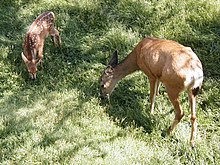

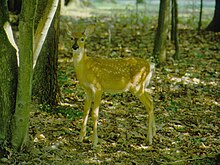
In shaded areas they are non so easy to encounter
The deer family has nigh 62 species.
- Family Cervidae
- Subfamily Hydropotinae: Water deer
- Genus Hydropotes
- Water deer, Hydropotes inermis
- Genus Hydropotes
- Subfamily Muntiacinae: Muntjacs
- Genus Muntiacus: Muntjacs
- Genus Elaphodus
- Tufted deer, Elaphodus cephalophus
- Subfamily Capreolinae: New World deer
- Genus Capreolus
- Roe deer, Capreolus capreolus
- Siberian roe deer, Capreolus pygargus
- Genus Odocoileus
- White-tailed deer, Odocoileus virginianus
- Mule deer, Odocoileus hemionus
- Genus Ozotoceros
- Pampas deer, Ozotoceros bezoarticus
- Genus Blastocerus
- Marsh deer, Blastocerus dichotomus
- Genus Mazama: Brocket deer
- Genus Pudu: Pudú
- Genus Rangifer
- Reindeer, Rangifer tarandus
- Genus Hippocamelus: Andean deer
- Genus Alces
- Moose, Alces alces
- Genus Capreolus
- Subfamily Cervinae: Truthful deer, Former World deer
- Genus Centrality
- Chital, Axis axis
- Hog deer, Axis porcinus
- Bawean deer, Centrality kuhlii
- Calamian deer, Axis calamianensis
- Genus Elaphurus
- Père David's deer, Elaphurus davidianus
- Genus Cervus
- Red deer, Cervus elaphus
- Wapiti (Elk) Cervus canadensis
- White-lipped deer, Cervus albirostris
- Sika deer, Cervus japan
- Barasingha, Cervus duvaucelii
- Schomburgk'due south deer, Cervus schomburgki †
- Thamin, Cervus eldii
- Sambar deer, Cervus unicolor
- Rusa deer, Cervus timorensis
- Philippine deer, Cervus mariannus
- Philippine spotted deer, Cervus alfredi
- Genus Dama
- Dormant deer, Dama dama
- Genus Centrality
- Subfamily Hydropotinae: Water deer
Miscellaneous [modify | alter source]
The nearly famous fictional deer is Bambi.
References [change | alter source]
- ↑ The plural of 'Deer' is just 'Deer'.
- ↑ ii.0 2.i Pitraa, Christian et al 2004. Development and phylogeny of old globe deer. Molecular Phylogenetics and Development 33: 880–895. [ane]
- ↑ "ADW: Cervidae: Information". animaldiversity.ummz.umich.edu . Retrieved 29 July 2010.
- ↑ Malo A.F. et al 2005. Antlers honestly advertise sperm production and quality. Proceedings of the Royal Society of Biological Sciences. 272:149-157.
- ↑ Frädrich H 1984. "Deer". In Macdonald D. (ed) The Encyclopedia of Mammals. New York: Facts on File. pp. 518–9. ISBN 978-0-87196-871-v
- ↑ Geist, V. (1998). Deer of the World: their development, behaviour and ecology. Mechanicsburg, U.s.: Stackpole Books. pp. 1–54. ISBN978-0-8117-0496-0.
Other websites [change | change source]
Source: https://simple.wikipedia.org/wiki/Deer

Post a Comment for "Deer Baby What Is a Baby Deer Called"