In Regard to Slavery, What Did the Constitution Do?
We agree these truths to exist self-axiomatic, that all men are created equal, that they are endowed past their Creator with sure unalienable Rights, that amidst these are Life, Freedom and the pursuit of Happiness.
— Declaration of Independence, 1776
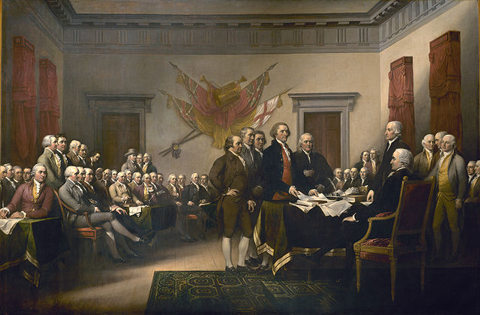 |
| Thomas Jefferson presented the Declaration of Independence to the Continental Congress in 1776. (Wikimedia Commons) |
When the American colonies broke from England, the Continental Congress asked Thomas Jefferson to write the Announcement of Independence. In the proclamation, Jefferson expressed American grievances and explained why the colonists were breaking abroad. His words proclaimed America's ethics of freedom and equality, which still resonate throughout the earth.
Yet at the fourth dimension these words were written, more than 500,000 blackness Americans were slaves. Jefferson himself endemic more than 100. Slaves accounted for nigh one-fifth of the population in the American colonies. Most of them lived in the Southern colonies, where slaves fabricated up 40 percent of the population.
Many colonists, even slave holders, hated slavery. Jefferson called it a "hideous blot" on America. George Washington, who owned hundreds of slaves, denounced information technology as "repugnant." James Mason, a Virginia slave owner, condemned information technology every bit "evil."
But even though many of them decried it, Southern colonists relied on slavery. The Southern colonies were among the richest in America. Their cash crops of tobacco, indigo, and rice depended on slave labor. They weren't going to requite information technology up.
The showtime U.S. national government began under the Articles of Confederation, adopted in 1781. This document said nothing about slavery. Information technology left the ability to regulate slavery, as well as almost powers, to the individual states. After their experience with the British, the colonists distrusted a strong central government. The new national government consisted solely of a Congress in which each land had one vote.
With little power to execute its laws or collect taxes, the new government proved ineffective. In May 1787, 55 delegates from 12 states met in Philadelphia. (Rhode Isle refused to send a delegation.) Their goal was to revise the Manufactures of Confederation. Coming together in secret sessions, they quickly changed their goal. They would write a new Constitution. The outline of the new government was soon agreed to. Information technology would have three branches — executive, judiciary, and a two-business firm legislature.
A dispute arose over the legislative co-operative. States with large populations wanted representation in both houses of the legislature to exist based on population. States with small populations wanted each country to have the same number of representatives, like nether the Articles of Confederation. This argument carried on for ii months. In the end, the delegates agreed to the "Great Compromise." One branch, the Business firm of Representatives, would be based on population. The other, the Senate, would have two members from each land.
Function of this compromise included an issue that split up the convention on North–S lines. The effect was: Should slaves count every bit part of the population? Under the proposed Constitution, population would ultimately determine iii matters:
(1) How many members each state would have in the House of Representatives.
(ii) How many balloter votes each state would have in presidential elections.
(3) The amount each land would pay in direct taxes to the federal government.
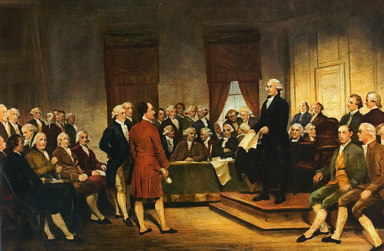 |
| In 1787 after months of debate, delegates signed the new Constitution of the Us. (Wikimedia Commons) |
Simply the Southern states had large numbers of slaves. Counting them as part of the population would greatly increase the South's political ability, simply it would likewise hateful paying higher taxes. This was a price the Southern states were willing to pay. They argued in favor of counting slaves. Northern states disagreed. The delegates compromised. Each slave would count every bit iii-fifths of a person.
Following this compromise, another controversy erupted: What should be done about the slave trade, the importing of new slaves into the United States? X states had already outlawed it. Many delegates heatedly denounced it. Merely the 3 states that allowed it — Georgia and the two Carolinas — threatened to leave the convention if the trade were banned. A special committee worked out some other compromise: Congress would have the power to ban the slave trade, only not until 1800. The convention voted to extend the engagement to 1808.
A concluding major issue involving slavery confronted the delegates. Southern states wanted other states to render escaped slaves. The Articles of Confederation had not guaranteed this. Only when Congress adopted the Northwest Ordinance, it a clause promising that slaves who escaped to the Northwest Territories would exist returned to their owners. The delegates placed a similar fugitive slave clause in the Constitution. This was part of a deal with New England states. In substitution for the fugitive slave clause, the New England states got concessions on aircraft and trade.
These compromises on slavery had serious furnishings on the nation. The fugitive slave clause (enforced through legislation passed in 1793 and 1850) allowed escaped slaves to be chased into the North and caught. It also resulted in the illegal kidnapping and return to slavery of thousands of free blacks. The three-fifths compromise increased the South's representation in Congress and the Electoral College. In 12 of the showtime xvi presidential elections, a Southern slave owner won. Extending the slave trade past 1800 brought many slaves to America. South Carolina alone imported 40,000 slaves between 1803 and 1808 (when Congress overwhelmingly voted to end the trade). And then many slaves entered that slavery spilled into the Louisiana territory and took root.
Northern states didn't push likewise hard on slavery bug. Their main goal was to secure a new regime. They feared antagonizing the South. Most of them saw slavery equally a dying institution with no economical futurity. However, in v years the cotton fiber gin would be invented, which made growing cotton fiber on plantations immensely profitable, likewise as slavery.
The Proclamation of Independence expressed lofty ideals of equality. The framers of the Constitution, intent on making a new government, left important questions of equality and fairness to the hereafter. It would be some fourth dimension before the great republic that they founded would approach the ideals expressed in the Declaration of Independence.
For Word and Writing
- What were the ethics of equality expressed in the Declaration of Independence?
- Why was slavery so important to the South?
- Do yous call up the framers of the Constitution could take limited or banned slavery? Why or why non?
For Farther Reading
Horton, James Oliver. Slavery and the Making of America. New York: Oxford Academy Press. 2005.
Davis, David Brion. Inhuman Bondage: The Rise and Fall of Slavery in the New World. New York: Oxford University Press. 2006.
Berlin, Ira. Many Thousands Gone: The Offset 2 Centuries of Slavery in North America. Cambridge: Harvard College. 1998.
Render to Black History Month Home Folio
Source: https://www.crf-usa.org/black-history-month/the-constitution-and-slavery

Post a Comment for "In Regard to Slavery, What Did the Constitution Do?"