what was purchased according to the louisiana purchase
| Louisiana Purchase Vente de la Louisiane | |||||||||||
|---|---|---|---|---|---|---|---|---|---|---|---|
| Expansion of the United states of america | |||||||||||
| 1803–1804 | |||||||||||
 Modern map of the United States overlapped with territory bought in the Louisiana Purchase (in white) | |||||||||||
| History | |||||||||||
| History | |||||||||||
| • Established | July 4, 1803 | ||||||||||
| • Disestablished | October 1, 1804 | ||||||||||
| |||||||||||
| Today role of |
| ||||||||||


The Louisiana Buy (French: Vente de la Louisiane, lit.'Auction of Louisiana') was the acquisition of the territory of Louisiana past the United States from the French First Democracy in 1803. In return for fifteen million dollars, or approximately eighteen dollars per square mile, the United states of america nominally acquired a total of 828,000 sq mi (ii,140,000 km2; 530,000,000 acres). However, France merely controlled a small fraction of this area, most of it inhabited by Native Americans; for the majority of the area, what the United States bought was the "preemptive" right to obtain "Indian" lands by treaty or by conquest, to the exclusion of other colonial powers.[1] [2] The full cost of all subsequent treaties and financial settlements over the land has been estimated to be around ii.6 billion dollars.[one] [2]
The Kingdom of France had controlled the Louisiana territory from 1699 until information technology was ceded to Spain in 1762. In 1800, Napoleon, the Get-go Consul of the French republic, regained ownership of Louisiana as function of a broader project to re-establish a French colonial empire in Due north America. However, France's failure to put downward a defection in Saint-Domingue, coupled with the prospect of renewed warfare with the United Kingdom, prompted Napoleon to consider selling Louisiana to the Usa. Acquisition of Louisiana was a long-term goal of President Thomas Jefferson, who was specially eager to proceeds control of the crucial Mississippi River port of New Orleans. Jefferson tasked James Monroe and Robert R. Livingston with purchasing New Orleans. Negotiating with French Treasury Government minister François Barbé-Marbois (who was acting on behalf of Napoleon), the American representatives quickly agreed to purchase the entire territory of Louisiana after it was offered. Overcoming the opposition of the Federalist Party, Jefferson and Secretary of State James Madison persuaded Congress to ratify and fund the Louisiana Buy.
The Louisiana Purchase extended United States sovereignty across the Mississippi River, most doubling the nominal size of the land. The buy included land from fifteen present U.South. states and two Canadian provinces, including the entirety of Arkansas, Missouri, Iowa, Oklahoma, Kansas, and Nebraska; large portions of Northward Dakota and South Dakota; the area of Montana, Wyoming, and Colorado e of the Continental Dissever; the portion of Minnesota west of the Mississippi River; the northeastern section of New Mexico; northern portions of Texas; New Orleans and the portions of the present land of Louisiana west of the Mississippi River; and small portions of land inside Alberta and Saskatchewan. At the time of the purchase, the territory of Louisiana'due south non-native population was around 60,000 inhabitants, of whom half were enslaved Africans.[three] The western borders of the purchase were later settled past the 1819 Adams–Onís Treaty with Spain, while the northern borders of the buy were adapted by the Treaty of 1818 with Britain.
Background

Throughout the second half of the 18th century, the French colony of Louisiana became a pawn for European political intrigue.[4] The colony was the most substantial presence of France'southward overseas empire, with other possessions consisting of a few small settlements along the Mississippi and other main rivers. France ceded the territory to Spain in 1762 in the hole-and-corner Treaty of Fontainebleau. Following French defeat in the Seven Years' War, Spain gained command of the territory westward of the Mississippi, and the British received the territory to the east of the river.[5]
Following the establishment of the The states, the Americans controlled the area east of the Mississippi and north of New Orleans. The chief event for the Americans was free transit of the Mississippi to the ocean. As the lands were being gradually settled by American migrants, many Americans, including Jefferson, assumed that the territory would be acquired "piece past piece." The risk of another power taking it from a weakened Kingdom of spain made a "profound afterthought" of this policy necessary.[iv] New Orleans was already of import for shipping agricultural appurtenances to and from the areas of the United States due west of the Appalachian Mountains. Pinckney's Treaty, signed with Espana on Oct 27, 1795, gave American merchants "correct of deposit" in New Orleans, granting them use of the port to store appurtenances for export. The treaty also recognized American rights to navigate the entire Mississippi, which had become vital to the growing merchandise of the western territories.[5]
In 1798, Espana revoked the treaty allowing American utilize of New Orleans, greatly upsetting Americans. In 1801, Castilian Governor Don Juan Manuel de Salcedo took over from the Marquess of Casa Calvo, and restored the American right to eolith appurtenances. However, in 1800 Spain had ceded the Louisiana territory back to France as part of Napoleon's underground Third Treaty of San Ildefonso.[six] The territory nominally remained under Castilian command, until a transfer of ability to France on November 30, 1803, but three weeks before the formal cession of the territory to the United States on Dec 20, 1803.[7]
Negotiation

The future president James Monroe equally envoy extraordinary and minister plenipotentiary to France helped Robert R. Livingston in negotiating the Louisiana Buy
While the transfer of the territory past Kingdom of spain back to France in 1800 went largely unnoticed, fright of an eventual French invasion spread across America when, in 1801, Napoleon sent a armed forces force to secure New Orleans. Southerners feared that Napoleon would complimentary all the slaves in Louisiana, which could trigger slave uprisings elsewhere.[8] Though Jefferson urged moderation, Federalists sought to use this confronting Jefferson and chosen for hostilities against France. Undercutting them, Jefferson threatened an alliance with the Great britain, although relations were uneasy in that direction.[8] In 1801, Jefferson supported France in its plan to have back Saint-Domingue (nowadays-24-hour interval Haiti), which was then under control of Toussaint Louverture afterward a slave rebellion. Jefferson sent Livingston to Paris in 1801[9] with the authorisation to purchase New Orleans.
In January 1802, French republic sent Full general Charles Leclerc on an expedition to Saint-Domingue to reassert French control over a colony that had become essentially autonomous under Louverture. Louverture, as a French general, had fended off incursions from other European powers, just had also begun to consolidate power for himself on the island. Earlier the revolution, French republic had derived enormous wealth from St. Domingue at the cost of the lives and freedom of the slaves. Napoleon wanted its revenues and productivity for French republic restored. Alarmed over the French actions and its intention to re-establish an empire in Due north America, Jefferson declared neutrality in relation to the Caribbean area, refusing credit and other assistance to the French, just assuasive war contraband to get through to the rebels to prevent France from regaining a foothold.[10]
In 1803, Pierre Samuel du Pont de Nemours, a French nobleman, began to assistance negotiate with France at the asking of Jefferson. Du Pont was living in the United States at the time and had shut ties to Jefferson too as the prominent politicians in France. He engaged in dorsum-channel affairs with Napoleon on Jefferson'south behalf during a visit to France and originated the idea of the much larger Louisiana Buy as a fashion to defuse potential disharmonize between the Us and Napoleon over Due north America.[11]
Throughout this fourth dimension, Jefferson had up-to-date intelligence on Napoleon's military activities and intentions in N America. Role of his evolving strategy involved giving du Pont some information that was withheld from Livingston. Desperate to avoid possible war with French republic, Jefferson sent James Monroe to Paris in 1803 to negotiate a settlement, with instructions to go to London to negotiate an brotherhood if the talks in Paris failed. Spain procrastinated until late 1802 in executing the treaty to transfer Louisiana to French republic, which allowed American hostility to build. Also, Espana'southward refusal to cede Florida to France meant that Louisiana would be indefensible. Monroe had been formally expelled from France on his last embassy, and the choice to transport him over again conveyed a sense of seriousness.
Napoleon needed peace with the United Kingdom to take possession of Louisiana. Otherwise, Louisiana would be an easy prey for a potential invasion from Britain or the U.South. But in early 1803, continuing war between France and the UK seemed unavoidable. On March 11, 1803, Napoleon began preparing to invade Great Uk.[ citation needed ]
In Saint-Domingue, Leclerc's forces took Louverture prisoner, but their expedition soon faltered in the face of fierce resistance and disease. By early 1803, Napoleon decided to abandon his plans to rebuild France'southward New World empire. Without sufficient revenues from sugar colonies in the Caribbean, Louisiana had little value to him. Spain had not all the same completed the transfer of Louisiana to France, and state of war between France and the UK was imminent. Out of anger towards Spain and the unique opportunity to sell something that was useless and not truly his yet, Napoleon decided to sell the entire territory.[12]
Although the foreign government minister Talleyrand opposed the plan, on April ten, 1803, Napoleon told the Treasury Minister François Barbé-Marbois that he was considering selling the entire Louisiana Territory to the United States. On April 11, 1803, just days earlier Monroe's inflow, Barbé-Marbois offered Livingston all of Louisiana for $15 1000000,[thirteen] which averages to less than three cents per acre (7¢/ha).[14] [15] The full of $xv million is equivalent to virtually $323 million in 2020 dollars, or 61 cents per acre. The American representatives were prepared to pay up to $x million for New Orleans and its environs but were dumbfounded when the vastly larger territory was offered for $xv one thousand thousand. Jefferson had authorized Livingston only to buy New Orleans. Nevertheless, Livingston was certain that the United States would have the offering.[16]
The Americans thought that Napoleon might withdraw the offer at whatever time, preventing the The states from acquiring New Orleans, so they agreed and signed the Louisiana Buy Treaty on April 30, 1803, at the Hôtel Tubeuf in Paris.[17] The signers were Robert Livingston, James Monroe, and François Barbé-Marbois.[18] After the signing Livingston famously stated, "We have lived long, but this is the noblest piece of work of our whole lives... From this day the United States take their identify amongst the powers of the first rank."[19] On July iv, 1803, the treaty was appear,[20] but the documents did not make it in Washington, D.C. until July 14.[21] The Louisiana Territory was vast, stretching from the Gulf of Mexico in the south to Rupert'southward Land in the northward, and from the Mississippi River in the east to the Rocky Mountains in the west. Acquiring the territory doubled the size of the Us.
In November 1803, France withdrew its 7,000 surviving troops from Saint-Domingue (more two-thirds of its troops died there) and gave up its ambitions in the Western Hemisphere.[22] In 1804 Haiti declared its independence; but fearing a slave revolt at home, Jefferson and the balance of Congress refused to recognize the new republic, the 2nd in the Western Hemisphere, and imposed a trade embargo against information technology. This, together with the successful French demand for an indemnity of 150 million francs in 1825, severely hampered Haiti'southward ability to repair its economic system after decades of war.[23]
Domestic opposition and constitutionality

The original treaty of the Louisiana Purchase
After Monroe and Livingston had returned from France with news of the purchase, an official announcement of the purchase was made on July 4, 1803. This gave Jefferson and his chiffonier until Oct, when the treaty had to be ratified, to discuss the constitutionality of the purchase. Jefferson considered a constitutional amendment to justify the buy; however, his cabinet convinced him otherwise. Jefferson justified the purchase past rationalizing, "it is the case of a guardian, investing the coin of his ward in purchasing an important next territory; & maxim to him when of age, I did this for your good." Jefferson ultimately came to the determination before the ratification of the treaty that the buy was to protect the citizens of the Usa therefore making it constitutional.[24]
Henry Adams and other historians take argued that Jefferson acted hypocritically with the Louisiana Buy, considering of his position equally a strict constructionist regarding the Constitution since he stretched the intent of that document to justify his purchase.[25] The American buy of the Louisiana territory was non accomplished without domestic opposition. Jefferson's philosophical consistency was in question considering of his strict interpretation of the Constitution. Many people believed that he and others, including James Madison, were doing something they surely would take argued against with Alexander Hamilton. The Federalists strongly opposed the purchase, favoring close relations with Britain over closer ties to Napoleon.[ citation needed ]
Both Federalists and Jeffersonians were concerned over the purchase'southward constitutionality. Many members of the Firm of Representatives opposed the purchase. Majority Leader John Randolph led the opposition. The House called for a vote to deny the request for the buy, just it failed by two votes, 59–57. The Federalists even tried to bear witness the land belonged to Espana, not France, but available records proved otherwise.[26] The Federalists also feared that the ability of the Atlantic seaboard states would be threatened by the new citizens in the West, whose political and economic priorities were spring to conflict with those of the merchants and bankers of New England. There was besides business that an increase in the number of slave-belongings states created out of the new territory would exacerbate divisions between North and Southward besides. A group of Northern Federalists led by Senator Timothy Pickering of Massachusetts went then far as to explore the idea of a separate northern confederacy.
Another concern was whether information technology was proper to grant citizenship to the French, Spanish, and free black people living in New Orleans, as the treaty would dictate. Critics in Congress worried whether these "foreigners", unacquainted with democracy, could or should go citizens. The U.S. Government had to use English common police to make them citizens to collect taxes.[27]
Kingdom of spain protested the transfer on two grounds: First, France had previously promised in a note non to alienate Louisiana to a third political party and second, French republic had not fulfilled the Tertiary Treaty of San Ildefonso by having the King of Etruria recognized by all European powers. The French government replied that these objections were baseless since the promise non to amerce Louisiana was not in the treaty of San Ildefonso itself and therefore had no legal strength, and the Castilian government had ordered Louisiana to be transferred in October 1802 despite knowing for months that Britain had non recognized the Rex of Etruria in the Treaty of Amiens.[28]

Henry Adams claimed "The sale of Louisiana to the United States was trebly invalid; if it were French property, Bonaparte could non constitutionally alienate it without the consent of the French Chambers; if it were Castilian belongings, he could non alienate it at all; if Spain had a correct of reclamation, his sale was worthless."[29] The sale of course was not "worthless"—the U.S. actually did take possession. Furthermore, the Castilian prime minister had authorized the U.South. to negotiate with the French regime "the acquisition of territories which may adjust their interests." Spain turned the territory over to France in a anniversary in New Orleans on November xxx, a calendar month earlier French republic turned it over to American officials.[thirty]
Other historians counter the above arguments regarding Jefferson'south alleged hypocrisy by asserting that countries modify their borders in two ways: (1) conquest, or (2) an agreement betwixt nations, otherwise known as a treaty. The Louisiana Purchase was the latter, a treaty. The Constitution specifically grants the president the power to negotiate treaties (Art. Ii, Sec. 2), which is just what Jefferson did.[31]
Madison (the "Father of the Constitution") assured Jefferson that the Louisiana Purchase was well within even the strictest interpretation of the Constitution. Treasury Secretarial assistant Albert Gallatin added that since the ability to negotiate treaties was specifically granted to the president, the simply way extending the country's territory by treaty could not be a presidential power would exist if it were specifically excluded by the Constitution (which information technology was non). Jefferson, as a strict constructionist, was correct to be concerned about staying inside the premises of the Constitution, but felt the power of these arguments and was willing to "acquiesce with satisfaction" if the Congress canonical the treaty.[32] The Senate quickly ratified the treaty, and the Firm, with equal alacrity, authorized the required funding, as the Constitution specifies.[33] The fledgling United States did non have $fifteen one thousand thousand in its treasury; it borrowed the sum from Uk, at an annual interest rate of 6 percentage.[34] The Usa Senate advised and consented to ratification of the treaty with a vote of twenty-four to seven on October 20. On the following mean solar day, October 21, 1803, the Senate authorized Jefferson to take possession of the territory and plant a temporary military regime. In legislation enacted on October 31, Congress made temporary provisions for local civil government to continue every bit it had under French and Spanish rule and authorized the President to use military forces to maintain order. Plans were also set forth for several missions to explore and chart the territory, the about famous being the Lewis and Clark Expedition.[24]
The opposition of New England Federalists to the Louisiana Purchase was primarily economic cocky-involvement, non any legitimate business concern over constitutionality or whether French republic indeed endemic Louisiana or was required to sell it back to Spain should it want to dispose of the territory. The Northerners were not enthusiastic about Western farmers gaining another outlet for their crops that did non require the use of New England ports. Also, many Federalists were speculators in lands in upstate New York and New England and were hoping to sell these lands to farmers, who might go west instead, if the Louisiana Purchase went through. They also feared that this would lead to Western states being formed, which would probable be Republican, and dilute the political power of New England Federalists.[33] [35]
When Espana later on objected to the U.s. purchasing Louisiana from French republic, Madison responded that America had first approached Kingdom of spain virtually purchasing the property but had been told by Spain itself that America would have to treat with France for the territory.[36]
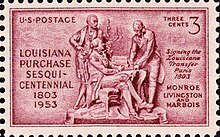
Issue of 1953, commemorating the 150th Anniversary of signing
Formal transfers and initial system

France turned over New Orleans, the historic colonial capital, on December xx, 1803, at the Cabildo, with a flag-raising ceremony in the Plaza de Armas, now Jackson Foursquare. Merely three weeks earlier, on November xxx, 1803, Spanish officials had formally conveyed the colonial lands and their administration to France.
On March 9 and ten, 1804, another ceremony, commemorated every bit Three Flags Mean solar day, was conducted in St. Louis, to transfer ownership of Upper Louisiana from Espana to France, and then from France to the United states. From March 10 to September 30, 1804, Upper Louisiana was supervised equally a military district, under its first civil commandant, Amos Stoddard, who was appointed by the State of war Department.[37] [38]
Effective October 1, 1804, the purchased territory was organized into the Territory of Orleans (virtually of which would become the land of Louisiana) and the District of Louisiana, which was temporarily under control of the governor and judicial system of the Indiana Territory. The following year, the District of Louisiana was renamed the Territory of Louisiana.[39] New Orleans was the administrative capital of the Orleans Territory, and St. Louis was the capital of the Louisiana Territory.[40]
Financing
The American regime used $iii one thousand thousand in gold as a down payment and issued bonds for the balance to pay French republic for the buy. Before that year, Francis Baring and Company of London had become the U.S. regime's official banking agent in London following the failure of Bird, Cruel & Bird. Because of this favored position, the U.S. asked the Baring firm to handle the transaction. Francis Baring's son Alexander was in Paris at the time and helped in the negotiations.[41] Another Baring reward was a shut relationship with Hope and Company of Amsterdam. The two banking houses worked together to facilitate and underwrite the buy.[ citation needed ] Although the War of the 3rd Coalition, which brought France into a war with the United kingdom of great britain and northern ireland, began earlier the purchase was completed, the UK allowed the deal to proceed as it was better for the neutral Americans to own the territory than the hostile French.[42]
Because Napoleon wanted to receive his money as apace every bit possible, the two firms received the American bonds and shipped the gold to France.[41] Napoleon used the money to finance his planned invasion of England, which never took place.[43]
Boundaries
A dispute presently arose between Spain and the United States regarding the extent of Louisiana. The territory's boundaries had not been defined in the 1762 Treaty of Fontainebleau that ceded it from French republic to Spain, nor in the 1801 Third Treaty of San Ildefonso ceding it back to France, nor the 1803 Louisiana Purchase agreement ceding information technology to the The states.[44]

The Purchase was one of several territorial additions to the U.Southward.
The U.S. claimed that Louisiana included the entire western portion of the Mississippi River drainage basin to the crest of the Rocky Mountains and land extending to the Rio Grande and Westward Florida.[45] Spain insisted that Louisiana comprised no more than the western depository financial institution of the Mississippi River and the cities of New Orleans and St. Louis.[46] The dispute was ultimately resolved past the Adams–Onís Treaty of 1819, with the United States gaining about of what it had claimed in the westward.
The relatively narrow Louisiana of New Spain had been a special province nether the jurisdiction of the Captaincy Full general of Cuba, while the vast region to the due west was in 1803 notwithstanding considered part of the Commandancy General of the Provincias Internas. Louisiana had never been considered one of New Kingdom of spain's internal provinces.[47] If the territory included all the tributaries of the Mississippi on its western banking company, the northern reaches of the purchase extended into the as ill-defined British possession—Rupert's Land of British Northward America, now part of Canada. The purchase originally extended just beyond the 50th parallel. However, the territory n of the 49th parallel (including the Milk River and Poplar River watersheds) was ceded to the UK in exchange for parts of the Red River Basin s of 49th parallel in the Anglo-American Convention of 1818.[48] [49]
The eastern boundary of the Louisiana purchase was the Mississippi River, from its source to the 31st parallel, though the source of the Mississippi was, at the time, unknown. The eastern boundary below the 31st parallel was unclear. The U.S. claimed the land as far as the Perdido River, and Spain claimed that the border of its Florida Colony remained the Mississippi River. The Adams–Onís Treaty with Kingdom of spain resolved the event upon ratification in 1821. Today, the 31st parallel is the northern boundary of the western half of the Florida Panhandle, and the Perdido is the western boundary of Florida.[l]
Considering the western boundary was contested at the time of the purchase, President Jefferson immediately began to organize three missions to explore and map the new territory. All iii started from the Mississippi River. The Lewis and Clark Expedition (1804) traveled up the Missouri River; the Red River Expedition (1806) explored the Red River basin; the Pike Expedition (1806) as well started up the Missouri only turned south to explore the Arkansas River watershed. The maps and journals of the explorers helped to define the boundaries during the negotiations leading to the Adams–Onís Treaty, which set the western boundary every bit follows: north up the Sabine River from the Gulf of United mexican states to its intersection with the 32nd parallel, due north to the Red River, up the Carmine River to the 100th height, north to the Arkansas River, upwards the Arkansas River to its headwaters, due north to the 42nd parallel and due west to its previous purlieus.[ citation needed ]
Slavery
Governing the Louisiana Territory was more hard than acquiring it. Its European peoples, of ethnic French, Spanish and Mexican descent, were largely Catholic; in addition, at that place was a large population of enslaved Africans made up of a high proportion of recent arrivals, every bit Spain had continued the transatlantic slave trade. This was particularly true in the area of the present-day state of Louisiana, which also contained a large number of free people of color. Both present-24-hour interval Arkansas and Missouri already had some slaveholders in the 18th and early 19th century.[ commendation needed ]
During this period, south Louisiana received an influx of French-speaking refugee planters, who were permitted to bring their slaves with them, and other refugees fleeing the large slave revolt in Saint-Domingue. Many Southern slaveholders feared that acquisition of the new territory might inspire American-held slaves to follow the example of those in Saint-Domingue and revolt. They wanted the U.South. authorities to establish laws allowing slavery in the newly acquired territory so they could be supported in taking their slaves there to undertake new agricultural enterprises, as well as to reduce the threat of future slave rebellions.[51]
The Louisiana Territory was cleaved into smaller portions for administration, and the territories passed slavery laws similar to those in the southern states merely incorporating provisions from the preceding French and Spanish rule (for instance, Spain had prohibited slavery of Native Americans in 1769, simply some slaves of mixed African-Native American descent were still being held in St. Louis in Upper Louisiana when the U.S. took over).[52] In a freedom adjust that went from Missouri to the U.S. Supreme Court, slavery of Native Americans was finally ended in 1836.[52] The institutionalization of slavery under U.S. law in the Louisiana Territory contributed to the American Civil War a half century later.[51] Every bit states organized inside the territory, the status of slavery in each land became a matter of contention in Congress, as southern states wanted slavery extended to the west, and northern states just as strongly opposed new states beingness admitted as "slave states." The Missouri Compromise of 1820 was a temporary solution.[ citation needed ]
Asserting U.Southward. possession

Programme of Fort Madison, congenital in 1808 to establish U.Due south. control over the northern part of the Louisiana Purchase, fatigued 1810
Afterward the early explorations, the U.South. government sought to institute control of the region, since trade forth the Mississippi and Missouri rivers was still dominated by British and French traders from Canada and centrolineal Indians, specially the Sauk and Fox. The U.S. adjusted the former Spanish facility at Fort Bellefontaine as a fur trading post about St. Louis in 1804 for business organization with the Sauk and Pull a fast one on.[53] In 1808 2 military forts with trading factories were congenital, Fort Osage along the Missouri River in western present-twenty-four hours Missouri and Fort Madison forth the Upper Mississippi River in eastern present-day Iowa.[54] With tensions increasing with Great Britain, in 1809 Fort Bellefontaine was converted to a U.S. military fort and was used for that purpose until 1826.[55]
During the War of 1812, Groovy Britain hoped to annex all or at least portions of the Louisiana Purchase should they successfully defeat the U.S. Aided past their Indian allies, the British defeated U.South. forces in the Upper Mississippi; the U.Due south. abandoned Forts Osage and Madison, besides as several other U.S. forts built during the war, including Fort Johnson and Fort Shelby. U.S. ownership of the whole Louisiana Purchase region was confirmed in the Treaty of Ghent (ratified in February 1815) and guaranteed on the battlefield at the decisive Boxing of New Orleans when the British sent over 10,000 of the best British Army soldiers to try to take New Orleans in a 5 calendar month long campaign starting from September 1814 (First Battle of Fort Bowyer) to February 1815 (Second Battle of Fort Bowyer). Nobody really knows what mail service-victory plans for New Orleans and Upper Louisiana were given by the British authorities to Major General Sir Edward Pakenham and his 2d-in-command Major General Samuel Gibbs because both generals were killed in activeness at the Battle of New Orleans. Pakenham was ordered to comport the New Orleans/Mobile campaign even in the middle of the peace negotiations in late 1814. The British would take likely garrisoned New Orleans and would have occupied it for a very long time considering they and their ally Kingdom of spain did not recognize any treaties and land deals conducted by Napoleon since 1800, specially the Louisiana Purchase.[56] The U.S. later built or expanded forts forth the Mississippi and Missouri rivers, including adding to Fort Bellefontaine, and constructing Fort Armstrong (1816) and Fort Edwards (1816) in Illinois, Fort Crawford (1816) in Wisconsin, Fort Snelling (1819) in Minnesota, and Fort Atkinson (1819) in Nebraska.[54]
Impact on Native Americans

Louisiana Purchase territory shown as American Indian land in Gratiot's map of the defences of the western & due north-western frontier, 1837.
The Louisiana Purchase was negotiated betwixt France and the Usa, without consulting the various Indian tribes who lived on the land and who had not ceded the land to whatsoever colonial power. The iv decades following the Louisiana Purchase was an era of court decisions removing many tribes from their lands east of the Mississippi, culminating in the Trail of Tears.[57]
The purchase of the Louisiana Territory led to the debate over the thought of indigenous land rights leading all the style into the mid 20th century. The many court cases and tribal suits for historical damages post-obit the Louisiana Buy in the 1930s led to the Indian Claims Committee Human activity (ICCA) in 1946. Felix S. Cohen, Interior Department Lawyer who helped pass ICCA, is oftentimes quoted every bit saying, "practically all of the real estate caused by the United States since 1776 was purchased not from Napoleon or whatever other emperor or czar only from its original Indian owners", roughly estimating that Indians had received twenty times as much every bit French republic had for the territory bought by the The states, "somewhat in backlog of 800 million dollars".[1] [2] The toll has been more recently estimated as 2.6 billion dollars, but this is nonetheless far lower than the true value of the land.[1] [two]
Come across also
- Alaska Purchase
- Corps of Discovery
- Florida Purchase
- Foreign affairs of the Jefferson administration
- Franco-American alliance
- Historic regions of the United States
- List of French possessions and colonies
- Louisiana Purchase Historic State Park
- Territorial evolution of the United States
- Territories of the United states of america on stamps
- Lewis and Clark National Historic Trail
Notes
- ^ a b c d Lee, Robert (March 1, 2017). "The Truthful Toll of the Louisiana Purchase". Slate . Retrieved October 1, 2019.
- ^ a b c d Lee, Robert (March 1, 2017). "Accounting for Conquest: The Cost of the Louisiana Purchase of Indian Land". Journal of American History. 103 (4): 921–942. doi:10.1093/jahist/jaw504.
- ^ "Congressional series of United States public documents". U.S. Government Printing Office. 1864 – via Google Books.
- ^ a b Herring (2008), p. 99.
- ^ a b Meinig (1995), p.[ page needed ].
- ^ Warren, Rebecca (1976). The Role of American Diplomacy in the Louisiana Purchase. Dissertations and Theses (Thesis). Portlad State University. doi:10.15760/etd.2578. Paper 2581. Archived from the original on Oct xiii, 2017 – via PDXScholar.
- ^ "Louisiana Purchase". Britannica. Archived from the original on May 25, 2017. Retrieved July 21, 2017.
- ^ a b Herring (2008), p. 100.
- ^ "Milestones: 1801–1829 – Office of the Historian". history.state.gov. Archived from the original on January 31, 2017. Retrieved February 19, 2017.
- ^ Matthewson (1995), p. 221.
- ^ Duke (1977), pp. 77–83.
- ^ Herring (2008), p. 101.
- ^ Kuepper, Justin (October 8, 2012). "three Of The Most Lucrative State Deals In History". Archived from the original on April 23, 2015. Retrieved April 12, 2015.
- ^ Burgan (2002), p. 36.
- ^ "Primary Documents of American History: Louisiana Purchase". Spider web Guides. Library of Congress. March 29, 2011. Archived from the original on March 2, 2011. Retrieved March 26, 2014.
- ^ Malone, Roeder & Lang (1991), p. 30.
- ^ – via Wikisource.
- ^ Alain Chappet, Roger Martin, Alain Pigeard, Le guide de Napoleon: 4000 lieux de mémoire pour revivre l'épopée (Paris: Tallandier, 2005), p. 307. ISBN 978-2847342468
- ^ "America's Louisiana Purchase: Noble Bargain, Hard Journey". LPB. Archived from the original on June 10, 2010. Retrieved June xi, 2010.
- ^ "The Louisiana Purchase: Jefferson'south constitutional gamble". National Constitution Center. Oct twenty, 2017. Archived from the original on April 30, 2018. Retrieved April 29, 2018.
- ^ "Purchase of Louisiana, [v July 1803]". Founders Online. National Archives and Records Administration. Footnote 2. Archived from the original on April 30, 2018. Retrieved April 29, 2018.
- ^ Matthewson (1995), p. 209.
- ^ Matthewson (1996), pp. 22–23.
- ^ a b "The Louisiana Purchase". Monticello . Retrieved March 28, 2020.
- ^ Rodriguez (2002), pp. 139–xl.
- ^ Fleming (2003), pp. 149ff.
- ^ Nugent (2009), pp. 65–68.
- ^ Gayarre (1867), p. 544.
- ^ Adams (2011), pp. 56–57.
- ^ Nugent (2009), pp. 66–67.
- ^ Lawson & Seidman (2008), pp. 20–22.
- ^ Banning (1995), pp. 7–ix, 178, 326–327, 330–333, 345–346, 360–361, 371, 384.
- ^ a b Ketcham (2003), pp. 420–422.
- ^ "Jefferson and the Louisiana Purchase". Archived from the original on June ten, 2015.
America did non accept the money to pay the $15 1000000 outright so they instead borrowed the money from United kingdom of great britain and northern ireland at 6% interest.
- ^ Lewis (2003), p. 79.
- ^ Peterson, Merrill D. (1974). "James Madison: A Biography in his Ain Words". Newsweek. pp. 237–46.
- ^ Stoddard, Amos (2016). Stoddard, Robert A. (ed.). The Autobiography Manuscript of Major Amos Stoddard. CreateSpace Independent Publishing Platform. p. 67−69. ISBN978-1537593593.
- ^ Stoddard, Amos (1812). Sketches, Historical and Descriptive, of Louisiana. Mathew Carey. p. 103. ISBN9780608399270.
- ^ "The commune of Louisiana changed to the territory of Louisiana". See chapter iii, "Treaty Ceding Louisiana to the U.s.a." (1803 ff.), Laws of a Public and General Nature: Of the District of Louisiana, of the Territory of Louisiana, of the Territory of Missouri, and of the State of Missouri, Up to the Yr 1824 (Jefferson City MO: W. Lusk, 1842), half-dozen.
- ^ Olbrich, Jr., William 50. (2004). "The Land of Missouri". In Shearer, Benjamin F. (ed.). The Uniting States: Louisiana to Ohio. The Uniting States: The Story of Statehood for the 50 Us. Vol. 2. Connecticut: Greenwood Publishing Group. p. 672. ISBN978-0-313-33106-0.
- ^ a b Ziegler (1988), p.[ page needed ].
- ^ "Financing the Louisiana Purchase". The Tontine Coffee-Business firm. Nov 19, 2018. Retrieved May iii, 2020.
- ^ Fleming (2003), pp. 129ff.
- ^ Schoultz (1998), pp. 15–sixteen.
- ^ Haynes (2010), pp. 115–116.
- ^ Hämäläinen (2008), p. 183.
- ^ Weber (1994), pp. 223, 293.
- ^ 8 Stat. 248
- ^ "Treaties in Force" (PDF). United States Department of Land. Retrieved July xiv, 2015.
- ^ "Statutes & Constitution :Constitution : Online Sunshine". www.leg.country.fl.the states . Retrieved March 20, 2020.
- ^ a b Herring (2008), p. 104.
- ^ a b Foley, William E. (October 1984). "Slave Freedom Suits earlier Dred Scott: The Instance of Marie Jean Scypion's Descendants". Missouri Historical Review. 79 (1): i. Archived from the original on Jan xiii, 2013. Retrieved February 18, 2011 – via The State Historical Society of Missouri.
- ^ Luttig (1920), p.[ page needed ].
- ^ a b Prucha (1969), p.[ page needed ].
- ^ Browman, David L (2018). Cantonment Belle Fontaine 805-1826 The First U.Southward. Fort West of the Mississippi River. Washington University in St. Louis Press. pp. 4 and 7.
- ^ Drez, Ronald J. (2014). The State of war of 1812, conflict and deception: the British try to seize New Orleans and nullify the Louisiana Buy. Baton Rouge: Louisiana Country Academy Press. ISBN978-0-8071-5931-half dozen.
- ^ Marasco, Sue A. "Indian (Native American) Removal". 64 Parishes Encyclopedia of Louisiana. Louisiana Endowment for the Humanities. Retrieved October 1, 2019.
References
- Adams, Henry (2011) [1889]. History of the U.s.a. of America (1801–1817). Vol. ii: During the First Administration of Thomas Jefferson. Cambridge Academy Press. ISBN978-1108033039.
- Banning, Lance (1995). The Sacred Fire of Liberty: James Madison and the Founding of the Federal Commonwealth . Ithaca: Cornell University Press. ISBN9780801431524.
- Burgan, Michael (2002). The Louisiana Buy. Capstone. ISBN978-0756502102.
- Cerami, Charles A. (2003). Jefferson's Keen Gamble . Sourcebooks. ISBN978-1402234354.
- Duke, Marc (1977). The du Ponts: Portrait of a Dynasty. Saturday Review Printing. ISBN0-8415-0429-6.
- Fleming, Thomas J. (2003). The Louisiana Purchase. John Wiley & Sons. ISBN978-0-471-26738-6.
- Gayarre, Charles (1867). History of Louisiana.
- Hämäläinen, Pekka (2008). The Comanche Empire. Yale Academy Press. ISBN978-0-300-12654-9.
- Haynes, Robert V. (2010). The Mississippi Territory and the Southwest Borderland, 1795–1817. University Printing of Kentucky. ISBN978-0-8131-2577-0.
- Herring, George (2008). From Colony to Superpower: U.Southward. Foreign Relations Since 1776. Oxford University Press. ISBN978-0-xix-976553-9.
- Ketcham, Ralph (2003). James Madison: A Biography. Newtown CT: American Political Biography Press. ISBN978-0813912653.
- Kennedy, David M.; Cohen, Lizabeth & Bailey, Thomas Andrew (2008). The American Pageant: A History of the American People. Wadsworth. ISBN978-0-547-16654-4.
- Lawson, Gary & Seidman, Guy (2008). The Constitution of Empire: Territorial Expansion and American Legal History. Yale University Printing. ISBN978-0300128963.
- Lewis, James E., Jr. (2003). The Louisiana Purchase: Jefferson'due south Noble Bargain?. UNC Press Books.
- Luttig, John C. (1920). Periodical of a Fur-trading Expedition on the Upper Missouri: 1812–1813. Kansas Metropolis MO: The Missouri Historical Society.
- Malone, Michael P.; Roeder, Richard B. & Lang, William 50. (1991). Montana: A History of Two Centuries. Seattle: University of Washington Press. ISBN0-295-97129-0.
- Matthewson, Tim (May 1995). "Jefferson and Haiti". The Journal of Southern History. 61 (two): 209–48. doi:10.2307/2211576. JSTOR 2211576.
- Matthewson, Tim (March 1996). "Jefferson and the Not-Recognition of Republic of haiti". American Philosophical Society. 140 (1): 22–48. JSTOR 987274.
- Meinig, D.W. (1995). The Shaping of America: Volume 2. Yale Academy Printing. ISBN978-0300062908.
- Nugent, Walter (2009). Habits of Empire: A History of American Expansionism. Random House. ISBN978-1-4000-7818-9.
- Prucha, Francis P. (1969). The Sword of the Republic: The Us Ground forces on the Frontier 1783–1846. New York: Macmillan.
- Rodriguez, Junius P. (2002). The Louisiana Purchase: A Historical and Geographical Encyclopedia. ABC-CLIO. ISBN978-1576071885.
- Schoultz, Lars (1998). Beneath the United States. Harvard University Press. ISBN978-0-674-92276-1.
- Thompson, Linda (2006). The Louisiana Purchase. Rourke Publishing. ISBN978-1-59515-513-9.
- Weber, David J. (1994). The Castilian Borderland in North America. Yale University Press. ISBN978-0-300-05917-5.
- Ziegler, Philip (1988). The Sixth Great Power: Barings 1762–1929. London: Collins. ISBN0-00-217508-8.
Further reading
| External video | |
|---|---|
 Booknotes interview with Jon Kukla on A Wilderness So Immense: The Louisiana Purchase and the Destiny of America, July 6, 2003, C-SPAN Booknotes interview with Jon Kukla on A Wilderness So Immense: The Louisiana Purchase and the Destiny of America, July 6, 2003, C-SPAN |
- Hermann, Binger (1900). The Louisiana Purchase and our title west of the Rocky Mountains: with a review of annexation by the United States. U.Southward. Government Printing Function.
- Hosmer, James Kendall (1902). The history of the Louisiana purchase. New York, D. Appleton and Company.
- Howard, James Quay (1902). History of the Louisiana purchase. Chicago, Callaghan & Visitor.
- Chocolate-brown, Everett Somerville (1920). The constitutional history of the Louisiana Purchase, 1803-1812. Berkeley, Academy of California Press.
- Lass, William E. (2015). "The Northern Boundary of the Louisiana Purchase". Great Plains Quarterly. 35 (1): 27–fifty. doi:x.1353/gpq.2015.0006. S2CID 161440918.
- Marshall (1914). A History of the Western Boundary of the Louisiana Purchase, 1819–1841. Academy of California Press.
- U.South. Dept. of Country (1903). State papers and correspondence bearing upon the purchase of the territory of Louisiana. U.S. Government Printing Office.
- Whitridge, Arnold (July 1953). "The Louisiana Purchase, 1803: America Moves Westward". History Today. 3 (seven): 476–483.
External links
- Case and Controversies in U.S. History, Folio 42 Senator Pickering explains his opposition to the Louisiana Purchase, 1803.
Source: https://en.wikipedia.org/wiki/Louisiana_Purchase

Post a Comment for "what was purchased according to the louisiana purchase"